Umpire Position Card
MechanicsPosition CardsPrintable
Reflects the 2026 NFHS rules year. Built from the 2026 and 2027 NFHS Football Game Officials Manual — §4.7 Positioning (pp. 136–141), §4.8 Coverage (pp. 142–150) and §1.9 Snap Location After Kick or Penalty (pp. 32–34). Last checked September 2, 2026.
Verify against the current rule book and VPA guide before teaching this as authoritative.
Your spot, your keys and your jobs, situation by situation — the Umpire's card for a crew of five. You are the white marker on every diagram.
Download the Umpire Position Card (PDF, 2 pages) — print at 100% on Letter, two-sided, flip on the long edge.
Associations amend these — check Vermont's guidance before teaching it.
Run and pass
Snap between the –10 and the +10.
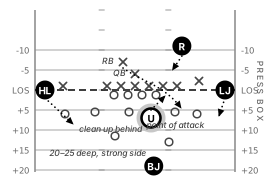
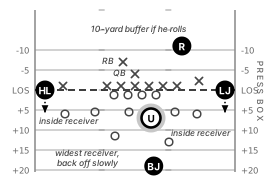
What you do
- 5–10 yards behind B's line, between the defensive ends, opposite wherever the Referee is. Vary your position laterally, shoulders parallel to the goal line.
- Count A's eleven with the Referee, and count A's five ineligible linemen and check their numbers. Punch up to confirm with referee.
- Run: interior line play with the emphasis at the point of attack, then the action on the tackled runner.
- Pass: quick pass means no time to reach the line. Delayed pass, read the crossing end or the screen behind the linemen, then move up.
Your keys
- Run — snap · linemen · blocking at the point of attack · the runner.
- Pass — snap · linemen · QB · the pass · the catch.
- You rule the trapped pass, behind or beyond the line.
- Check the passer's spot of release with the Referee when he arrives.
Your spot
| Run / pass | 5–10 yds behind B's line, between the defensive ends. You must see the ball from the snapper's first touch until the snap. |
| Punt | 4–7 yds deep, favouring the Line Judge's sideline. |
| Goal line | 5–10 behind B's line. Vary laterally. |
| Backed up | 5–10 behind B's line, unchanged. |
Turn immediately when the pass is thrown, then jog to the dead-ball spot.
Spotting
| Shoulders | Parallel to the sideline when you spot it, then move off the ball quickly. |
| Hurry-up | You're the sprinter. Grab it, spot it off the backside wing, get to your spot. |
| Bad weather | Hold it and keep a towel over it at the spot. |
| Voice | Strong voice after the whistle. It prevents more fouls than a flag does. |
Kicks
Free kick and scrimmage kick.
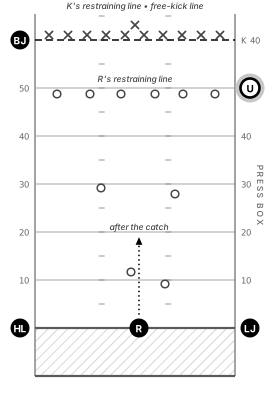
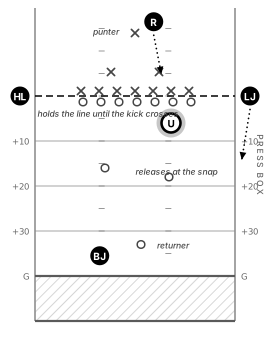
What you do
- Kickoff: the receivers' free-kick line — the 50 — two yards out of bounds on the press box side, the side opposite the chains, bean bag in hand.
- Jog up the far sideline and clear the restricted area, then raise your arm to the Referee when you're ready.
- After the kick, run to the near hash on the 50, then stop and watch. If the runner breaks it, you have inside-out and the Back Judge has the goal line.
- Punt: 4–7 yards deep, favouring the Line Judge's sideline. Punted 30 or less, stand and watch; more than 30, jog slowly downfield.
Your keys
- Kickoff — R's encroachment · onside · first touching · K's first contact by R's front line.
- Punt — snap · snapper · line play · turn and watch.
- Think onside on every kick. Bag in hand.
- Onside: R's free-kick line on the Line Judge's side, bag in hand for K's first touching. Kill it if a prone player from either team recovers, ten yards or not.
Your spot
| Kickoff | R's free-kick line (the 50), 2 yds out of bounds, press box side. |
| Onside | R's free-kick line, Line Judge's side. Bag in hand, line as a plane. |
| Punt | 4–7 yds deep, favouring the Line Judge's sideline — he releases at the snap. |
| Safety kick | Team K's 30. |
Pre-kick
| Ready | Clear the restricted area, then raise your arm to the Referee. |
| Pile | You and the Back Judge dig the ball out — find it before anyone signals. |
| After a punt | Jog downfield only once it's past 30 yards. |
Goal line and place kicks
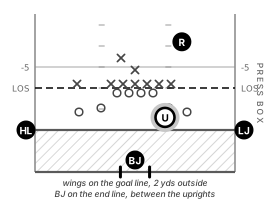
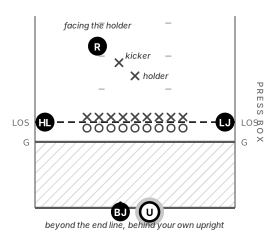
Snap on or inside the +10 · tee on the field.
What you do
- Goal line: 5–10 behind B's line between the ends, same as any scrimmage play.
- You never signal a touchdown. If you are certain and the wing hasn't signalled, go tell him — the call is his.
- Field goal and try: beyond the end line, behind the press box upright. You rule inside or outside your own upright. Tell the crew: no whistle.
- Do not spot the ball for the try until the captain tells the Referee where he wants it.
Your keys
- Place kick — snap · snapper · no fake · the numbering exception on a try.
- Watch the centre on the snap. Count "one-thousand-one, one-thousand-two" — direct contact inside two seconds is a foul.
- If it's a fake, stay on the end line initially.
- Short kick: get to the goal line and rule whether it breaks the plane.
Your spot
| Goal line | 5–10 behind B's line, between the defensive ends. |
| FG / try | Beyond the end line, behind the press box upright. Your upright is yours to rule. |
| Muddle huddle | Stand on the end line. |
Signalling
| Good | The Back Judge whistles and signals; you confirm your upright to him. |
| No good | Same — he signals, you confirm. In the end zone: no score, then touchback. |
| Whistle | Sound it when the kick is good or crosses the goal line. |
| Never | You do not signal a touchdown. Ever. |
Between downs, clock and fouls
Every down, all night.
What you do
- Penalty enforcement is yours. Turn to the calling official the moment the whistle sounds.
- 98% of the time you already know it. On the other 2%, look to the head coach with the wing beside him.
- Dig for the ball when the wings need it and hand it over — never throw or toss it.
- You matter most in the middle when tempers rise. Your presence does the work.
Your keys
- Walk it or jog it — your choice — but get it right.
- Don't look at the wings until they reach the succeeding spot.
- Five-yard walk-off close to a first down: ask the Head Line Judge to check the tape on the chain.
- Crew goal on a simple five-yard dead-ball foul: ball ready inside ten seconds.
Enforcement
| On the whistle | Turn to the calling official. |
| Walk-off | You walk it from the enforcement spot. The Line Judge holds the spot until it's right; the Head Line Judge walks it on the sideline with you. |
| Unsure | Look to the head coach, wing at his side. |
| Questions | Ask now. Not in the locker room. |
Between downs
| Relay | You're the end of the triangle. Spot it off the backside wing. |
| Close to a first | Dig it out and hand it to the wing who can see leather. |
| Timeout | Stay over the ball. |
| TV game | Stay over the ball until the Line Judge says they're ready. |
When you work a crew of 4
What changes for you.
- Counting: you and the Referee both count A on scrimmage downs and R on free kicks. The wings count B — and K on free kicks. (In a crew of 5 the Back Judge counts B.)
- Punt: you stay up. 10 yds deep favouring the Line Judge's side; the Line Judge goes deep with the returners.
- Field goal and try: nobody goes under a post. You're 10 yds off the line favouring the Line Judge's side. Snapped outside R's 15, the Line Judge is 5 yds behind the crossbar and rules the kick alone. Inside the 15 the Line Judge stays on the line, goes to the end line and signals the Referee, and the Referee rules whether it went through.
- Kickoff: you're on the sideline at the receivers' 20 and you count R. The Head Line Judge has K's free-kick line and the kicker; you own the area from the goal line to R's 30 on your side.
- Run and pass: you're the only official in the middle. Blocks beyond the point of attack are yours.