Referee Position Card
MechanicsPosition CardsPrintable
Reflects the 2026 NFHS rules year. Built from the 2026 and 2027 NFHS Football Game Officials Manual — §4.3 Keys (pp. 110–126), §4.7 Positioning (pp. 136–141) and §4.8 Coverage (pp. 142–150), with the crew-of-four differences from §3.7–3.8 (pp. 67–79). Last checked September 2, 2026.
Verify against the current rule book and VPA guide before teaching this as authoritative.
Your spot, your keys and your voice, situation by situation — the white hat's card for a crew of five. You are the white marker on every diagram.
Download the Referee Position Card (PDF, 2 pages) — print at 100% on Letter, two-sided, flip on the long edge.
Run and pass
Snaps beyond the 10 yard line.
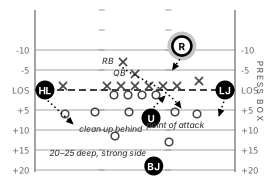
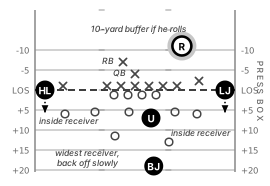
What you do
- Passing-arm side of the quarterback, 10 to 12 yards deep, at least as wide as the tight end. While A is in the huddle, 10–15 from the line and 5 wide of it, where the clock operator can see you.
- Count A with the Umpire — 11, held two seconds. A's substitutions in and out of the huddle are yours. Punch up to confirm with umpire.
- Mark the ball ready after A is behind their line, and on a first down only after the down box is set. Back-pedal to your spot first.
Your keys
- Run — snap · QB · handoff · QB · line play at the point of attack.
- Pass — snap · QB · the opposite tackle · the passer.
- Wide and deep enough that a pocket drop doesn't move you. If he rolls, move with him and keep at least a 10-yard buffer. Yell "ball's away."
- Passer near the line: memorize the spot of release and check beyond-or-behind with the Umpire.
Your spot
| Run | 10–12 back, passing-arm side, at least as wide as the tight end. |
| Pass | Same. 10-yard buffer if he rolls. |
| Backed up | Association practice, not the manual: 8 wide of the QB at 45° on the end line; from the –10 to the –15, 10 wide on the goal line. The manual keeps you at your normal spot. |
| Hurry-up | Don't move in as far. Tell the centre and QB to wait for your whistle. |
Say it out loud
| To B | Stay off the passer. Stay off the centre. |
| On release | Ball's away. |
| Backward pass | Signal it and yell "back." |
Kicks
Free kick and scrimmage kick.
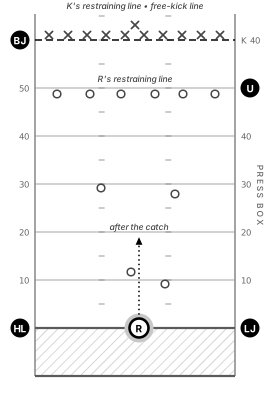
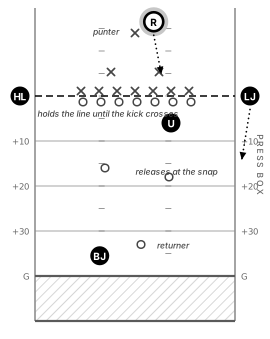
What you do
- Kickoff: straddle the receivers' goal line in the middle — wide side of a single returner, split two.
- Collect a raised arm from every wing and the Back Judge before you sound the ready. Nobody kicks without 11 and 11.
- Count four players on each side of the kicker. Fewer either side and you flag it and shut the kick down immediately.
- Punt: behind the kicker on his kicking-leg side — 2 to 3 yards back, 3 to 5 to the side. If he's in his own end zone, you're on the end line. Onside alignment is your call if the crew disagrees.
Your keys
- Kickoff — R touching the kick · wind · goal line and touchback · blocks ahead of the runner · clean up behind.
- Punt — snap · the kicker's catch · eligible backs' numbers · blocking by the backs · the kicker.
- Low snap and the kicker's knee. Roughing or running into: stay with him until there's no threat. Five-yard cushion on the kickoff until the goal line is safe.
Your spot
| Kickoff | Straddle the goal line, middle of the field. |
| Onside | Middle of the field, deeper than the deepest receiver. |
| Punt | 2–3 behind, 3–5 outside the kicker, kicking-leg side. |
| Safety kick | Receivers' 20. |
| Touchback | Signal it, then jog upfield sounding your whistle repeatedly. |
After the kick
| Kickoff | Move up watching blocks ahead of and around the runner. Once it's dead, swivel twice and clean up behind. |
| Punt | Jog to the line, stop, watch both teams. Long return: back-pedal to the goal line. |
| Bag | Momentum spot on a catch inside the 5. |
Goal line and place kicks
Snap on or inside the +10 · tee on the field.
What you do
- Goal line: same position as a run or pass — 10–12 back, passing-arm side.
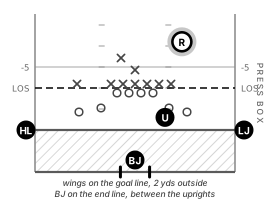
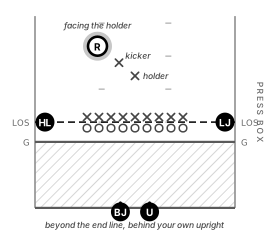
- Field goal and try: 2 to 3 yards to the rear and 3 to 5 to the side of the kicker, facing the holder.
- Call the tee and the kicker out loud the second they come on the field, and don't mark the ball ready until the Umpire reaches the end line.
- Stay with the kicker and holder until neither is threatened, then look to your deep officials for the result and relay their signal to the press box. What you never do is mirror a touchdown a wing has already signalled.
Your keys
- Place kick — eligible backs and the holder's number · snap · snapper · holder · catch · no fake · rushers · kicker and holder.
- Count "one-thousand-one, one-thousand-two" on the snapper. Direct contact inside two seconds is a foul.
- A blocked kick stays alive — back-pedal, you may be needed at the goal line.
- After a touchdown, watch the players moving toward the sideline.
Your spot
| Goal line | 10–12 back, passing-arm side. |
| FG / try | 2–3 to the rear, 3–5 to the side of the kicker, facing the holder. |
| Backed up | Point at both wings, then at the goal line, and get them to point back. |
| Ball reaches the 10 | No longer backed up — point at yourself, then at the goal line. |
Before the snap
| Tee comes on | Call it to the crew immediately. |
| Ready | Wait for your Umpire to reach the end line. |
| To B | Stay off the centre, the holder and the kicker. |
| After a TD | Ask the captain where he wants it spotted for the try. |
Between downs, clock and fouls
Every down, all night.
What you do
- Flag down: find the first open space and give your preliminary there. Do not walk around looking for a spot.
- The microphone is yours alone. Stand still, face the press box, announce the number, and keep it short.
- The Umpire enforces. You take the preliminary and the announcement.
- Coach conference: meet him at the sideline with the wing present and listen first. You explain the ruling, not the calling official.
Your keys
- One preliminary only for a simple five-yard dead-ball foul — false start, encroachment, delay, illegal substitution.
- Referee dead-ball action first. Penalize the first late hit.
- Check the scoreboard for the right number of timeouts before you mark it ready.
- On a loose ball, stop the clock after two seconds if nobody has signalled possession.
Clock
| Wind | On the ready facing the press box, or with your press-box-side arm when the snap is imminent. |
| Mirror | Wind twice when a wing winds twice. |
| First down | Signal once, immediately. No chopping. |
| Free kick | Caught between the hashes, you signal alone. In a side zone, you and the near wing. |
Housekeeping
| Timeout | Signal twice facing the press box, then point both arms at that team's goal line. |
| Out of timeouts | Two tugs on the steamboat whistle, then point at their goal line. |
| Relay | You're in the triangle on gains of less than about ten yards. |
| End of game | Signal the period, gather the crew, run off together. |
When you work a crew of 4
What changes for you.
- The play clock is yours. Announce five, then verbalize four, three, two, one.
- Half distance, automatic first down and loss of down come to you — that's the Back Judge's job in a crew of 5.
- Kickoff: you're at the top of the numbers at the receivers' 5 or 10 on the Line Judge's side, not the goal line in the middle. Your Head Line Judge is on K's free-kick line and your Line Judge on R's.
- Punt: the Line Judge goes deep with the returners and the Umpire sits 10 yards off the line, so the interior is thin. Widen your own clean-up behind the kick, and be ready to take the runner on a long return.
- Field goal and try: the Line Judge rules the kick — between the uprights from outside R's 15, on the crossbar from the end line inside it — so on a short try you rule whether it went through, and you echo his call either way.