Line Judge Position Card
MechanicsPosition CardsPrintable
Reflects the 2026 NFHS rules year. Built from the 2026 and 2027 NFHS Football Game Officials Manual — §4.7 Positioning (pp. 136–141) and §4.8 Coverage (pp. 142–150), with the crew-of-four deep-official duties from §3.7–3.8 (pp. 72–79). Last checked September 2, 2026.
Verify against the current rule book and VPA guide before teaching this as authoritative.
Your spot, your keys and your reads, situation by situation — the Line Judge's card for a crew of five. You work the press box sideline and you are the crew's backup game clock. You are the white marker on every diagram.
Download the Line Judge Position Card (PDF, 2 pages) — print at 100% on Letter, two-sided, flip on the long edge.
Associations amend these — check Vermont's guidance before teaching it.
Run and pass
Snap between the –10 and the +10.
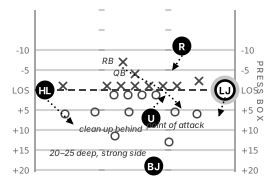
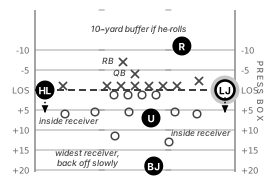
What you do
- Straddling the line of scrimmage, on the sideline — the manual strongly encourages working the sideline. Come off it once the play develops, but no further in than the numbers.
- You are the on-field backup timer for the game clock. Talk to the timer before the game.
- Know the line to gain before the snap and point it out to the Head Line Judge on third and fourth down.
- Count the players on the line on your side of centre and signal the Head Line Judge. Punch off the nearest player who's off it.
Your keys
- Run — snap · line play · blocks downfield · the runner.
- Pass — snap · player(s) · QB · zone · ball. Strong side: the inside receiver is yours. Weak side: the end nearest you. Never the Back Judge's key.
- Read the guard and tackle first, then the quarterback's eyes. His first look is usually where it goes.
- The sideline is yours, goal line to goal line.
The three pass reads, in order
- Flat / bubble — Stay home. Don't move until this read is done.
- Short / medium — Move downfield five, shoulders parallel, then stop. Adjust for a five-yard cushion from the receiver.
- Long — Turn and burn.
Straddle the sideline on a sideline catch. Give the catch signal only on the sideline — never into the field.
The clock is yours
| Before the game | Talk with the timer. You time halftime, weather delays and the interval before overtime. |
| Restart | Make sure the scoreboard actually starts after the signal. If it doesn't, everyone signals. |
| Down box wrong | Point above the Head Line Judge's head repeatedly. Soft whistle only if you must. |
| With the Referee | Signal clock status while he faces the press box. |
Kicks
Free kick and scrimmage kick.
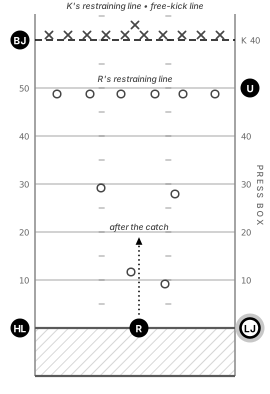
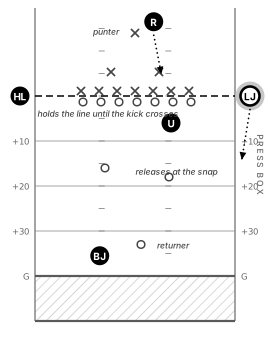
What you do
- Kickoff: R's goal line extended on the press box sideline — the same yard line as the Head Line Judge. Stand at the field numbers with a stop signal to the Referee until the clock reads 12:00.
- Move up if that team's first kick fell short, but stay level with your partner and deeper than the deepest receiver. Trail the runner by at least five yards.
- Punt: straddle the line, then release on the snap and work the space between the neutral zone and the receivers. Your partner holds the line.
- Your sideline is yours end line to end line; an out-of-bounds kick is live for you.
Your keys
- Kickoff — R touching the kick · wind · K out of bounds · blocks immediately ahead of the returner.
- Punt — snap · line play · blocking backs · your receivers · blocking. The Head Line Judge rules whether the kick crossed.
- Wind the clock only if the kick is caught or touched in your side zone.
- Kick out of bounds: flag at the spot, then hustle to the head coach for his choice.
Your spot
| Kickoff | R's goal line extended, press box sideline — same yard line as the Head Line Judge. |
| Onside | K's free-kick line (the 40), your sideline. Bag in hand, line as a plane. |
| Punt | Straddling the line on your sideline — release at the snap. Your sideline is yours end line to end line. |
| Safety kick | Adjust off the others: Back Judge at K's 20, Umpire and Head Line Judge at K's 30. |
After the punt
| 30 yards or less | Jog downfield 10, then stop and watch. |
| More than 30 | Jog downfield 15 to 20. |
| Rolls out deep | Look to the Back Judge — he has the angle and he won't come to the sideline. |
| Tipped | Give the tip signal twice. |
Goal line and place kicks
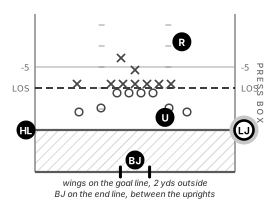
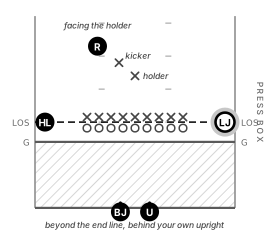
Snap on or inside the +10 · tee on the field.
What you do
- Goal line: two yards outside the sideline, on the goal line. Be standing on it before the ball arrives.
- You have primary responsibility for deciding a close first down. If it's close, stop the clock and look; if it isn't, start it.
- Close means measure. Secure a new ball after you mark the spot for the Head Line Judge and the chains.
- Field goal and try: straddle the line of scrimmage. You rule whether the kick crossed the neutral zone.
Your keys
- Place kick — snap · fake · the near tight end or wingback block.
- Never mirror a touchdown signal. Eye contact first.
- Be patient and find the ball before you sell anything.
- Fake on a try short of the goal line: mark forward progress only.
Your spot
| Goal line | 2 yds outside the sideline, on the goal line. |
| FG / try | Straddling the line of scrimmage. |
| Muddle huddle | 2 yds out of bounds, then hustle to the numbers if they shift to a kick. |
| Fake | Move immediately to the goal line, 2 yds outside the pylon. |
First down
| You decide | Best look from across the field, and you're usually downfield. |
| Close | Stop the clock and look. Then measure if it's close. |
| Don't measure | Forward stake beyond a hash and the spot behind the same hash, on a well-marked field. |
| Sprint in | Until you meet resistance. Yell for the ball if you can see leather. |
Between downs, clock and fouls
Every down, all night.
What you do
- Never spot the ball in the side zone. Mark it with your downfield foot and hold it for the Umpire.
- Runner out of bounds: stop the clock twice immediately, then turn and watch.
- The Umpire walks off the penalty. You hold the enforcement spot until it's done right; the Head Line Judge mirrors on the sideline. The wing tells the head coach the down and distance both ways.
- Sidelines are yours in a fight — keep non-players from leaving the bench.
Your keys
- Wind twice when the spot is inbounds between the numbers and the sideline, first down or not. No stop signal after the wind unless local custom asks for it.
- Cross-field help: move into the field toward the hash so your partner can see you.
- Hat, not flag, when an A or K player goes out of bounds on his own.
Clock duties
| Two minutes | Somebody must actually see the scoreboard stop. Say who. |
| Broken clock | Announce the time at nine, six, four and two minutes, loudly. |
| TV game | Hold the Referee and Umpire with a stop sign until the coordinator says they're ready. |
| Out of timeouts | Tell the head coach. |
Housekeeping
| Substitutes | Off the field on your sideline before the snap. |
| Measurement | Secure a new ball once the spot is marked. |
| Coin toss | On the hash mark on the press box side; the Back Judge is on the chain-side hash and the Head Line Judge stays on his sideline. |
| 5 yards or less | Move to the line to gain at the snap. |
When you work a crew of 4
What changes for you.
- You pick up clock status to the Referee — whether it starts on the ready or the snap. That's the Back Judge's job in a crew of 5.
- Kickoff: you're on R's free-kick line at the top of the numbers, not the goal line.
- Pass: every receiver on your side is yours, and the middle is dual coverage with the Head Line Judge.
- Punt: you are the deep official. 7 to 10 yards wider than and in front of the deepest receiver. Every deep receiver is yours, along with kicks down the middle, your side zone and getting to R's goal line for momentum and touchback.
- Goal line: step into the end zone to see a catch near the end line — nobody is on it.