Kicking Plays Crew Card
Reflects the 2026 NFHS rules year. Built from the 2026 and 2027 NFHS Football Game Officials Manual — §3.7–3.8 (crews of four, pp. 67–79), §4.7–4.8 (crews of five, pp. 136–150) and the 2026 Points of Emphasis on Free-Kick Coverage (p. 8). Last checked September 2, 2026.
Verify against the current rule book and VPA guide before teaching this as authoritative.
Where every official goes on kickoffs, onside kicks, punts, field goals and tries — for crews of five and crews of four.
Download the Kicking Plays Crew Card (PDF, 2 pages) — print at 100% on Letter, two-sided, flip on the long edge.
Associations amend these — the 4-man punt and the good/no-good call move most; check Vermont's guidance before teaching it.
In every diagram below the white marker is the Referee, and the press box is on the right.
Kickoff
Tee and kicker come on · free kick from K's 40.
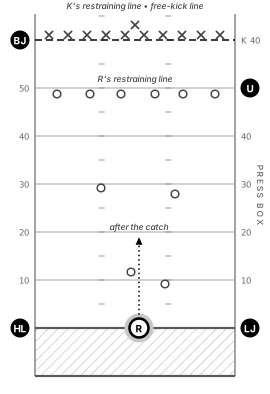
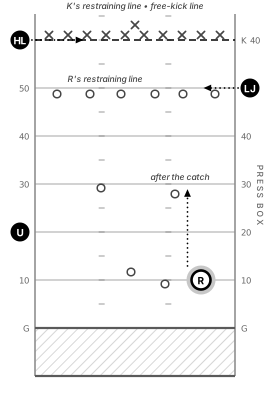
Everyone on this play
- Think onside first, every kick. Bag in hand outside the line.
- Raise an arm to the Referee when your count is good and your area is clear.
- Only the covering official winds the clock — between the hashes that's the Referee alone; in a side zone, him and the near wing.
- Trail the runner by five yards. Blocks ahead of him matter more than the spot.
Who has whom
- Widest two on each side of K's formation → the deepest official on that sideline. Hold your spot until the kick is possessed.
- Everyone else on K → the two restraining-line officials, each his own side. The one on K's line also has action against the kicker.
Referee — white hat only
- Count four players on each side of the kicker. Fewer either side and you flag it and shut the kick down.
- Collect every raised arm, then sound the ready.
- Five-yard cushion; hold the goal line until it's no longer threatened. Rule the touchback, bag momentum inside the 5 — and when in doubt, touchback.
- On a touchback, signal it and jog upfield sounding your whistle repeatedly.
Positions
| Crew of 5 | Crew of 4 | |
|---|---|---|
| R | Straddles R's goal line, middle of the field. Four on each side of the kicker before you sound the ready. | Top of the numbers at R's 5 or 10, Line Judge's side. Same four-on-each-side check. |
| U | R's free-kick line (the 50), 2 yds out of bounds, press box side — the side opposite the chains. | Sideline at R's 20. |
| HL | R's goal line extended, own sideline. | K's free-kick line, moving toward the middle once the players are on. You hand the kicker the ball — not before K has 11 — and you have nobody but the kicker more than 5 yds off K's line. |
| LJ | R's goal line extended, own sideline, same yard line as the HL. | R's free-kick line, coming to the top of the numbers. |
| BJ | K's free-kick line, 2 yds out of bounds, HL's side. Check the tee, hold the ball until K has 11, remind the kicker to wait for the whistle, and note nobody but the kicker more than 5 yds off K's line. | — |
Both wings on the same yard line, deeper than the deepest receiver if they move up. Crew of 4: Referee and both wings count Team R. Ball off the tee before the kick — whistle to prevent action, then go to the kicker.
Onside and short free kick
Score and time say they need it back.
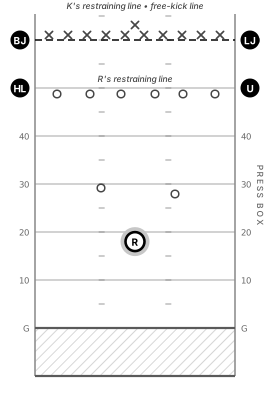
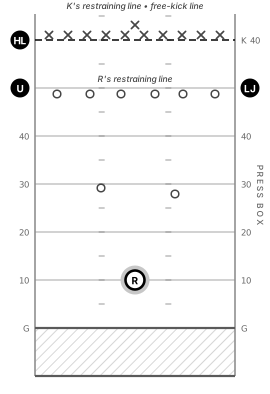
Everyone on this play
- Officiate your restraining line as a plane, bag in hand.
- Bag K's first touching, and kill it if a prone player from either team recovers — ten yards or not.
- Never signal that a short kick is expected. K cannot recover before the ball goes ten yards or is touched by R.
- On the pile, the restraining-line officials dig it out.
Referee — white hat only
- Middle of the field, deeper than the deepest receiver — not on the goal line. In a crew of 4, about R's 10.
- Short alignment is your call if the crew disagrees, and if a coach says in pregame his team kicks short, use it every time they kick.
Positions
| Crew of 5 | Crew of 4 | |
|---|---|---|
| R | Middle of the field, deeper than the deepest receiver. | About R's 10. |
| U | R's free-kick line (the 50), Line Judge's side. Bag in hand. | R's free-kick line. Bag in hand. |
| HL | R's free-kick line, own sideline. Bag in hand. | Your regular free-kick spot — K's line. Bag in hand. |
| LJ | K's free-kick line, own sideline. Bag in hand. | Your regular free-kick spot — R's line. Bag in hand. |
| BJ | K's free-kick line, HL's side. | — |
Crew of 5 makes a box: two officials on each restraining line, one per sideline. Crew of 4: the wings do not move — only the Referee and Umpire adjust.
Punt
4th down, K in scrimmage kick formation.
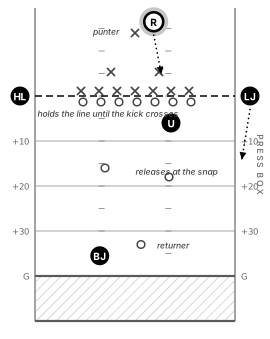
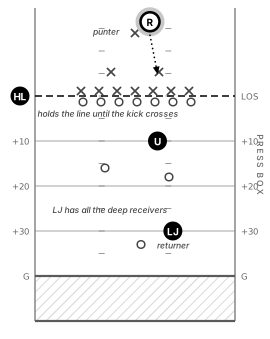
Everyone on this play
- The two wings do different things at the snap. The Head Line Judge stays on the line until the kick crosses the neutral zone — he rules whether it crossed. The Line Judge releases on the snap and works the space between the neutral zone and the receivers.
- Whoever covers it, beanbag the spot where the kick ends. That spot is what post-scrimmage-kick enforcement is measured from.
- The deep official has all the deep receivers, judges the fair catch, and owns the goal line, momentum and touchbacks.
- K is exempt from the 50–79 numbering rule; note the numbers in case they throw. Officiate the fake all the way through.
- Cover blocks ahead of the returner, not the ball.
Referee — white hat only
- Behind the kicker on his kicking-leg side — 2 to 3 back, 3 to 5 to the side. Not in front of him, and not off the wide side; ask in the pregame which foot he kicks with. Punter in his own end zone — you're on the end line.
- Tell R: stay off the center, stay off the punter. Watch for a low snap and the kicker's knee.
- Yell "ball's away." Roughing or running into — stay with the kicker until there is no threat, then jog to the line and stop. Long return: back-pedal to the goal line.
Positions
| Crew of 5 | Crew of 4 | |
|---|---|---|
| R | 3–5 yds outside the tight end, 2–3 yds behind the kicker, kicking-leg side. | 2–3 yds behind and 3–5 yds outside the punter, Line Judge's side. |
| U | 4–7 yds deep, favouring the Line Judge's sideline — he leaves at the snap and you cover for it. Move to the line at the snap, pivot to his side once both teams have run past. | 10 yds deep, favouring the Line Judge's sideline. Same pivot. |
| HL | Straddling the line on your sideline. Hold it until the kick crosses the neutral zone — you rule whether it crossed. Your sideline is yours end line to end line. | Same, and not closer than 9 yds outside the widest A player. |
| LJ | Straddling the line on your sideline. Release at the snap and work between the neutral zone and the receivers. Your sideline is yours end line to end line. | 7–10 yds wider than and in front of the deepest receiver — you are the deep official. |
| BJ | 10–12 yds wider than and 2–3 yds behind the deepest receiver, on the HL's side. Move up on a short kick, back if he retreats. | — |
In a crew of 4 the deep official is the Line Judge, not the Umpire. Every deep receiver is his, along with kicks down the middle and into his side zone, and getting to R's goal line for momentum and touchback. On a return up the middle he gives the runner up to the Umpire.
Field goal and try
Tee and place-kicker come on — call it out.
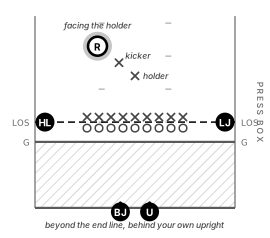
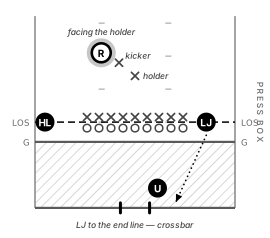
Everyone on this play
- Call the tee and kicker out loud the moment they come on.
- Wings rule whether the kick crossed the neutral zone, and help on ineligibles downfield on a fake. Nobody charges the snapper (9-4-6). A blocked try is dead at once; a blocked field goal stays alive unless it breaks the goal line plane.
Referee — white hat only
- 2 to 3 yards to the rear, 3 to 5 to the side of the kicker, facing the holder. Don't mark it ready until your deep officials are set.
- Keys: eligible backs and holder's number · snap · snapper · holder · catch · no fake · rushers · kicker and holder.
- Stay with the kicker and holder until neither is threatened, then look to the deep officials and relay their signal to the press box.
Positions
Crew of 5
| R | 2–3 yds to the rear, 3–5 yds to the side of the kicker, facing the holder. Relays the result to the press box. |
| U | Beyond the end line, behind the press box upright. Rules inside or outside your upright. |
| HL / LJ | Straddling the line of scrimmage. |
| BJ | Beyond the end line, behind the other upright. Rules your upright and the crossbar — and you sound the whistle and give the signal. |
Crew of 4 — nobody stands under a post. R is 1 yd behind and 2–3 to the side of the kicker, facing the holder; U is 10 yds off the line favouring the Line Judge's side, checking numbers and moving to the line at the snap; HL straddles the line not closer than 9 yds outside the widest A player. Both R and HL have roughing the holder and kicker. What changes is the LJ, and it turns on where the snap is:
- Outside R's 15 — LJ is 5 yds behind and directly between the uprights, and is the sole judge of good or no good. R echoes it to the press box.
- On or inside R's 15 — LJ starts on the line 5–7 yds outside the offensive end, then goes hard to the end line at the snap and rules the crossbar: thumbs-up to R if it clears, signal no good himself if it doesn't, then touchback. R rules whether it went through the uprights.
Field goal by free kick: chains set the 10-yard neutral zone; Referee and Umpire go behind the upright, the Umpire rules the crossbar, both judge the kick. Everyone else works it as a kickoff.
Settle these before the toss
The white hat runs it; everyone answers.
- Which foot the punter and the place kicker use. The Referee's spot on both kicks depends on it.
- Free kick after a safety, and after a fair catch. Both rare, both a different alignment.
- Counting. Referee and both wings count Team R; Umpire and Back Judge count Team K. No kick without 11 and 11 — and four on each side of the kicker.