Fouls & Enforcement Crew Card
MechanicsCrew CardsRulesPrintable
Reflects the 2026 NFHS rules year. Built from the 2026 and 2027 NFHS Football Game Officials Manual — §1.3 Flags and Penalties (pp. 20–22), §2.2 Penalty Signaling Sequences (pp. 48–51) and the 2026 Points of Emphasis on Penalty Communication (p. 5). Last checked September 2, 2026.
Verify against the current rule book and VPA guide before teaching this as authoritative.
Who throws it, who enforces it, who announces it. For crews of five and crews of four.
Download the Fouls & Enforcement Crew Card (PDF, 2 pages) — print at 100% on Letter, two-sided, flip on the long edge.
Associations amend these — check Vermont's guidance before teaching it.
In every diagram below the white marker is the Referee, and the press box is on the right. What is the Referee's alone appears under "Referee — white hat only."
Flag down
You see a foul · the ball is still live.
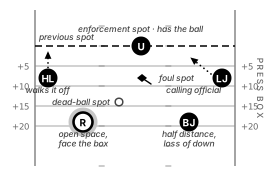
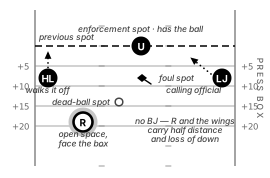
Everyone on this
- Tell two people, at once: the Referee and the Head Line Judge — so the chains and the down box freeze where they are. Three short whistle blasts after the ball is dead if you can't reach them any other way.
- No spot: throw it high in the air. Spot matters: throw it to the yard line. Off target — pick it up and move it definitively, now. The longer you wait the more it looks like you are manipulating it. Never throw a flag at a player, slam-dunk it or wave it.
- Dead-ball foul before the snap: jog toward the middle of the field to report it, still watching the players you just flagged — retaliation is coming.
- Two flags on one snap: get together and agree before any signal. Never signal a foul from the wing; your crewmate may have a different one on the same play.
Referee — white hat only
- Referee dead-ball action first. Penalize the first late hit — it usually ends the problem.
- Find the first open space and give your preliminary there. Do not walk around looking for a spot.
- You give one preliminary only for a simple five-yard dead-ball foul: false start, encroachment, delay, illegal substitution.
Who does what
| Crew of 5 | Crew of 4 | |
|---|---|---|
| Calling official | Stop the clock, then report to the Referee: foul, number, team, spot, result of the play. No preliminary signal from your position — the Referee gives the signal facing the press box. Describe it to the wing — "#88 held" won't sell it. | — |
| R | — | Same, and half distance and loss of down are yours. |
| U | Turn to the calling official on the whistle. Enforcement is yours from there. | Same as a crew of 5. |
| HL | Cover a spot foul. Keep the sideline clear, and freeze the chains and box the moment a flag is down — nothing moves until you say so. | Same. |
| LJ | Cover a spot foul. Keep the sideline clear. | Same, and you pick up clock status to the Referee. |
| BJ | Half distance, automatic first down, loss of down. | — |
Flag in front, tucked in — one or two, centre weighted, black ball.
Enforcing it
Ball is dead · flag is down.
Everyone on this
- The two wings do different things. The Head Line Judge walks the yardage off on his sideline while the Umpire walks it off in the field; the Line Judge holds the enforcement spot until he is certain it was done correctly.
- The wing on the penalized team's sideline tells the head coach the offending player's number and explains the foul in plain words — "the man in motion cut downfield too soon", not "illegal motion". Never guess a number. One invented number and the crew's credibility is gone.
- Identify teams as offence and defence, not by jersey colour.
- Ask your question now. A wrong enforcement gets fixed on the field, not in the locker room.
Referee — white hat only
- Enforcement belongs to the Umpire. Let him work it; you take the preliminary and the announcement.
- Crew goal on a simple five-yard dead-ball foul: ball marked ready inside ten seconds.
- Check the scoreboard for the right number of timeouts before you mark it ready.
Who does what
| Crew of 5 | Crew of 4 | |
|---|---|---|
| R | — | Half distance, automatic first down and loss of down are yours. |
| U | 98% of the time you already know it. On the other 2%, look to the head coach with the wing beside him. Walk it or jog it, but get it right. | Same as a crew of 5. |
| HL | Walk the yardage off on your sideline as the Umpire walks it in the field. Five-yard walk-off near a first down: check the chain tape. | Same as a crew of 5. |
| LJ | Hold the enforcement spot until you are certain the enforcement was done correctly. Don't leave it to walk with anybody. | Same as a crew of 5. |
| BJ | Half distance, automatic first down, loss of down — say it out loud, it gets missed. | — |
Announcing it
Preliminary given · enforcement set.
Everyone on this
- The microphone belongs to the Referee alone. If the crew can't hear it in the stadium, nobody uses it.
- Line Judge and Back Judge signal clock status to the Referee while he faces the press box.
Referee — white hat only
- Move clear of the players, face the press box, stand stationary, then signal. Think before you talk and pause for effect.
- Preliminary without the mic; final signal with it. You control the on/off switch, and you turn it off the moment you finish.
- Short phrases, pauses between them, normal voice — the speakers lag. Announce the player's number and skip the technical language.
- No microphone tonight? Verbalize the foul as you signal to the press box.
Say it like this
| Dead ball | Dead ball, false start, #79, offense, five yards, still first down. |
| Live ball | Illegal motion, #38, offense, five yards, repeat second down. |
| Automatic first | Roughing the passer, #41, defense, 15 yards, automatic first down. |
| Loss of down | Intentional grounding, #12, offense, five yards, loss of down, third down. |
Also announced
| Sideline warning | Sideline warning, name the school, their first. |
| Timeout | Timeout, offense, their first. |
| Out of timeouts | Two tugs on the steamboat whistle facing the press box, then point at that team's goal line. |
| Disqualification | Signal the DQ for each player ejected, on each team. |
Coach wants a conference
Rule 3-5 · he thinks a rule was misapplied.
Everyone on this
- This covers misapplication or misinterpretation of a rule. Judgment calls do not qualify — say so plainly and move on.
- The rule book, the case book and the mechanics manual have to be at the field. Not in the car.
- If he still disagrees, the crew gets the books, finds the ruling and shows him. Skipping this can cost an official up to two years.
Referee — white hat only
- Meet him at the sideline with the wing present, and listen before you talk.
- You can take it to the crew. Every official gets to speak — don't let the loudest one run the discussion.
- You explain the ruling to the coach, not the official who called it.
Who does what
| Crew of 5 | Crew of 4 | |
|---|---|---|
| R | Runs the conference and gives the ruling. Facilitates the crew discussion. | Same as a crew of 5. |
| HL / LJ | Stay with the Referee at the sideline. Keep the coach in his box and everyone else out of it. | One stays with the Referee, the other watches both teams. |
| U / BJ | Get the books, and watch the field — the players are unsupervised while this happens. | The Umpire gets the books. |
Tempers up
Prevention is the job; the fight is the failure.
- Allow no talking between opponents. Stop it the moment it starts. Pinch further into the field — your presence does the work, and the Umpire matters most in the middle.
- Penalize the first late hit. It is the single most effective thing you can do, and it usually ends the problem.
- Two players chest up or shove: get between them and stop it, then decide on penalties. Talk to the ones on the edge of a late hit but not late enough to call.
- Be assertive without being aggressive. Do not push a player down, tackle him, grab a facemask or pull anyone off a pile. Use the whistle.
- Players actually swinging: stand back and take numbers, keep others away, break it up once they are on the ground. Wings own the sidelines and keep the benches from emptying.
- After order is restored: huddle away from everyone, let every official speak, then assess penalties and disqualifications. The Referee tells each head coach at the sideline with a wing present. Signal dead ball and personal foul — not unsportsmanlike, there was contact.