Between Downs Crew Card
Reflects the 2026 NFHS rules year. Built from the 2026 and 2027 NFHS Football Game Officials Manual — §1.4 Whistle Mechanics (pp. 22–23), §4.4 Before and After the Snap (p. 127), §4.6 Measurements (pp. 130–135) and the 2026 Points of Emphasis on Forward Progress (p. 6). Last checked September 2, 2026.
Verify against the current rule book and VPA guide before teaching this as authoritative.
The whistle, the spot, the ball and the chains — the work between plays that makes a crew look sharp. For crews of five and crews of four.
Download the Between Downs Crew Card (PDF, 2 pages) — print at 100% on Letter, two-sided, flip on the long edge.
In every diagram below the white marker is the Referee, and the press box is on the right. What is the Referee's alone appears under "Referee — white hat only."
The whistle and the dead ball
See leather · the ball is dead.
Everyone on this
- See someone down. One short strong blast — not more than two, rarely three. Whistle on if there is a safety concern. See a helmet off, immediate whistle.
- Keep it in your mouth until the threat of a dead-ball foul is gone. Carry it in your hand during the down, not your mouth.
- Swivel your head twice and watch the players in your area instead of staring at the spot. Then raise an arm immediately for the next down.
- Repeated blasts mean a foul away from the play, a timeout, a coach who needs you, or opponents talking to each other.
Referee — white hat only
- You rarely need to run to the dead-ball spot at or beyond the line. Stay back, look around the whole scene, then get to your position.
- Mark the ball ready only when you are clear of all players.
- On a loose ball, stop the clock after two seconds if nobody has signalled possession.
Who does what
| Crew of 5 | Crew of 4 | |
|---|---|---|
| R | Whistle discipline for the crew. Wind the clock when a crewmate signals it. | Same, plus the play clock. |
| U | Strong voice after the whistle — it prevents more fouls than a flag does. | Same, and you cover the middle alone. |
| HL / LJ | Runner out of bounds: stop the clock twice immediately, then turn and watch. Swivel and watch them come back in. | Same as a crew of 5. One of you takes the opponent's bench area. |
| BJ | A player in the opponent's bench area: go into the team box and escort him back. | — |
Plastic whistle only. A finger whistle is fine, but you still owe approved signals with both arms.
Forward progress and the spot
Runner is down · mark it.
Everyone on this
- Downfield foot in front of the backfield foot. Square off. No angling in.
- The spot belongs to whoever can actually see the ball when the play is declared dead — not to whoever's side of the field it ended on. Usually that means hash to hash.
- Move into the field until you approach players, then stop. Close to the line to gain? Come all the way to the spot; wait for players to clear rather than going round or over them.
- Driven back between the numbers and the sideline: wind twice and move in — not past the players.
- Trapped pass: go slow. Squaring off and moving in says catch, so don't move until you know it is one.
Where the ball was
Two things at once: where the runner is down by rule, and where the forward-most point of the ball was when that happened.
| Knocked forward | Usually the spot is where the ball meets the turf. But if he was grabbed so his knee touched before he fell forward, the spot is where the ball was when the knee went down. |
| Sacked | There is often 3 to 5 yards between where the quarterback was contacted and where he goes down. Spot it where the ball landed and you got it wrong. |
| Out of bounds | The spot is the foremost point of the ball at the instant he touches out of bounds — not where his foot hit the line. Ball in his outside arm and the foot is about the rear point; ball in his inside arm and the foot is ahead of it. It rarely matters, except at the stake. |
| Airborne | Where the forward-most part of the ball crosses the plane of the sideline, not where the ball is when he first touches out of bounds. |
| Pushed back | He is entitled to his farthest advance. If he breaks free and renews the charge, he gets the farthest point of the subsequent advance. If he then staggers down untouched and you judge it was the original contact that did it, he is entitled to the spot where that contact occurred. |
| Stopped | Give him a chance to escape if one exists. If he is controlled and held, or carried back and put down, blow it. |
The rule benefits the offence except once: intercept in the end zone near the goal line, get tackled from behind, and the runner is "entitled" to a progress spot in the field of play — well behind the 20 he would have had on a touchback.
Referee — white hat only
- You mark progress behind the line. Everywhere else, let the covering official own it.
- Once a whistle sounds for progress, everyone swivels twice for dead-ball action.
- Wings that hug the sideline and never come off it are pretenders. Get them off it without running through players.
Who does what
| Crew of 5 | Crew of 4 | |
|---|---|---|
| R | — | Behind the line only. |
| U | Dig for the ball when the wings need it, and hand it over — never throw or toss it. | Same, plus deep progress in the middle. |
| HL / LJ | Cross-field help on passes and on a runner driven back near the sideline. The backside wing moves into the field toward the hash so your partner can actually see you. | Same as a crew of 5, with no help behind you. |
| BJ | Mark progress downfield, and relay the new ball as part of the triangle. | — |
Getting it back in play
Ball is dead · spot it and go.
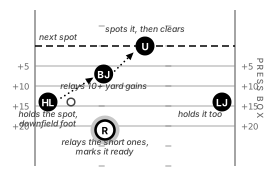
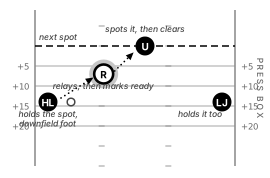
Everyone on this
- Wings never spot the ball in the side zone. Mark it with the downfield foot and hold it for the Umpire.
- The relay runs wing to middle to Umpire. Take the extra step rather than throwing it, and never throw it toward a sideline so it hits the ground.
- Watch dead-ball action first. Hunting a new ball while a foul happens behind you is how crews get beaten.
- Hurry-up: one ball as much as you can, and both wings hold the spot — the Umpire may take either one.
Referee — white hat only
- Hurry-up: don't move in as far when the ball is dead, and back-pedal to your position before you mark it ready.
- If the centre is over the ball before you're ready, tell him and the quarterback to wait for your whistle.
- The goal is that they never wait on us, except for a timeout or a measurement.
Who does what
| Crew of 5 | Crew of 4 | |
|---|---|---|
| R | — | You are the relay on every play, then you mark it ready. |
| U | The sprinter between downs. Grab it, spot it off the backside wing, shoulders parallel to the sideline, then move off quickly. | Same as a crew of 5. |
| HL / LJ | Hold the dead-ball spot. Do not spot it in the side zone. | Same as a crew of 5. |
| BJ | Relay on gains of about ten yards or more. On a deep incomplete pass, hustle it off the field while the wings get a new one. | — |
Change of possession: relay the old ball out once there's no threat of a dead-ball foul. Inclement weather: shorter relays, run it in when needed, towel over the ball at the spot.
First down and measuring
It looks close.
Everyone on this
- The covering official who can see the ball decides. If it's close, stop the clock and let the Referee call the measurement. If it isn't, start it.
- Close means measure. Refuse once and you'll be wrong all night in the coaches' eyes.
- Wings sprint in until they meet resistance. Whoever can see leather yells for the ball; the Umpire digs it out and hands it over.
Referee — white hat only
- Wings know the line to gain before the snap and point it out to each other. On third and fourth down, make sure they do.
- Signal the first down immediately, once. No chopping.
- Inbounds near the sideline on a first down: wind the clock so the crew knows he stayed in. Don't follow the wind with a stop signal unless local custom asks for it.
Who does what
| Crew of 5 | Crew of 4 | |
|---|---|---|
| LJ | Rule progress when you are the covering official with the ball in view. Secure a new ball after marking the spot for the chains. | Same as a crew of 5. |
| HL | Do not look over your shoulder. If the Line Judge is covering, hold your spot and let him rule it; if you are covering, the spot is yours. | Same as a crew of 5. |
| U | Dig for the ball and hand it to the wing. | Same as a crew of 5. |
On a synthetic or well-marked grass field, if the forward stake is beyond a hash and the spot is behind the same hash, don't measure.
Bags, hats and loose balls
What comes out of your pocket, and when.
- Fumble: blue bean bag up in the air at chest level. A bag in the air tells the crew the ball is loose and keeps whistles out of mouths. Get it on the correct yard line, not exactly at the spot.
- No bag for an interception, or for a backward pass behind the neutral zone. Beyond the neutral zone, bag the backward pass.
- Momentum inside the 5: drop the bag at the spot of the catch or the interception.
- The Back Judge carries two — the end of a scrimmage kick and first touching. No bag at an out-of-bounds spot on the sideline.
- Hat, not flag, when an A or K player goes out of bounds on his own. Muddy field: keep the hat and yell the number loudly.
- Change of possession: the covering official signals the new direction twice, then the timeout twice. Everyone else mirrors the timeout the moment they see it. On a pile, whoever rules possession yells the team colour.