Back Judge Position Card
MechanicsPosition CardsPrintable
Reflects the 2026 NFHS rules year. Built from the 2026 and 2027 NFHS Football Game Officials Manual — §4.4–4.8 (pp. 127–150) and §1.6 Play Clock Timer (pp. 27–28). Last checked September 2, 2026.
Verify against the current rule book and VPA guide before teaching this as authoritative.
Your spot, your keys and your jobs, situation by situation — the Back Judge's card for a crew of five. You are the white marker on every diagram.
Download the Back Judge Position Card (PDF, 2 pages) — print at 100% on Letter, two-sided, flip on the long edge.
Associations amend these — check Vermont's guidance before teaching it.
Run and pass
Snap between the –10 and the +10.
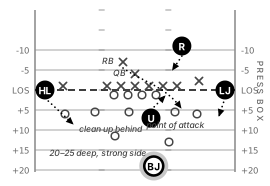
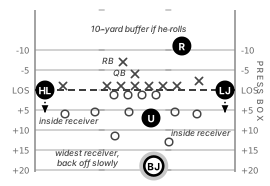
What you do
- Favouring the strong side of the formation, 20 to 25 yards beyond the line and deeper than the deepest defender. Hold that until the snap is on or inside B's 10 — then start on the end line.
- Count B's eleven and hold it two seconds. B's substitutions in and out of the huddle are yours.
- You own the play clock: five fingers at five seconds, then count down four, three, two, one. Reset to 25 with one arm up, palm up, pumped three times (S17); both arms the same way to reset to 40.
Your keys
- Run — snap · tight end and tackle · receivers · line play beyond the point of attack · the runner.
- Pass — snap · player(s) · QB · zone · ball. Your key is the widest receiver on the strong side; balanced means strong to the Line Judge's side.
- Read the guard and tackle first. On a run read stay home — don't back-pedal until the runner breaks the line.
- Watch the receivers for blocks and crackbacks. Talk to the borderline players.
Pass coverage
| Doubles | You have the widest receiver on the strong side; balanced formation, the widest on the Line Judge's side. |
| Trips | To the HL: you have the two widest, he has the inside one. To the LJ: you have the widest and he has the two inside — unless motion made the trips, when the two outside are yours. |
| Once they clear | Go to zone. |
| Prevent defense | Adjust your start to slightly behind the defensive backs. |
Moving
| Back off | Slowly. Don't take yourself out of the play by back-pedalling too fast. |
| Lock down | On the receiver and defender once you know where the ball is going. |
| Cushion | Five yards. Cross the receiver rather than trying to outrun him. |
| Support | Windshield wiper, sideline to sideline, behind the wings. |
Kicks
Free kick and scrimmage kick.
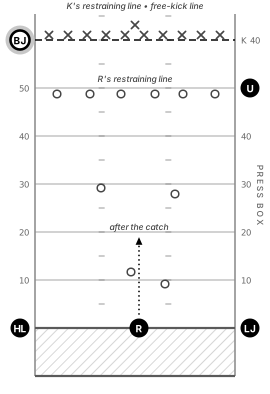
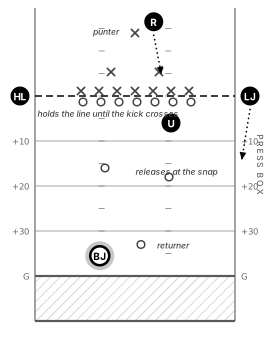
What you do
- Kickoff: K's free-kick line — the 40 — two yards out of bounds on the Head Line Judge's sideline, opposite the press box side, bean bag in hand.
- After the try, get a new ball near the upright, start your 60 seconds and jog up the press box sideline. Out to the kicker at 30 seconds.
- Check the tee, hand the kicker the ball, remind K to stay behind the line, clear the restricted area, then raise an arm to the Referee when you're ready.
- Punt: 10–12 yards wider than and 2–3 yards behind the deepest receiver, on the Head Line Judge's side. Heels on or inside the 10, stand on the goal line.
Your keys
- Kickoff — the kicker · K's encroachment · onside · first touching · K's first contact by R's front line.
- Punt — snap · the outside receiver(s) on the Line Judge's side · signals · first touching · the catch.
- You carry two bags: the end of the scrimmage kick and first touching.
- The goal line is yours on a punt, and so are touchbacks.
Your spot
| Kickoff | K's free-kick line (the 40), 2 yds out of bounds, opposite the press box. |
| Onside | K's free-kick line, Head Line Judge's side. Line as a plane. |
| Punt | 10–12 wider than and 2–3 behind the deepest receiver, on the Head Line Judge's side. Up on a short kick, back if he retreats. |
| Safety kick | Team K's 20 — the Umpire and Head Line Judge take K's 30. |
| Off the tee | Two whistle blasts and jog to the kicker. |
After the kick
| Kickoff | Run to the near hash at the 50, stop and watch K. Lead the runner and reach the goal line ahead of him. |
| Punt | Five-yard cushion, watching blocks. If the returner crosses your vision, let him go. |
| Out of bounds | You don't move to the sideline on a punt in flight — the wings look to you for the angle. |
| Bag | Drop it at the post-scrimmage-kick spot. |
Goal line and place kicks
Snap on or inside the +10 · tee on the field.
What you do
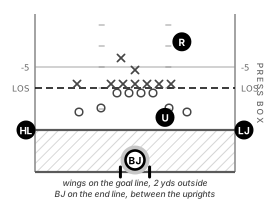
- Goal line: the end line, between the uprights. Stay on it while the ball is live.
- Hustle down the end line keeping a five-yard cushion with the receiver, and straddle it on a tight catch.
- Only you signal an incomplete pass on the end line — not the wings.
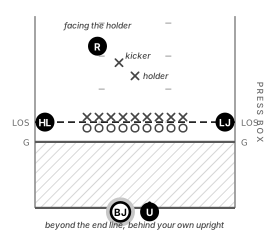
- Field goal and try: beyond the end line, behind the upright opposite the press box. You rule your own upright and the crossbar, and you sound the whistle and give the signal.
Your keys
- Place kick — if it's a fake, stay on the end line initially.
- Short kick: get to the goal line and rule whether it breaks the plane.
- Sound your whistle when the kick is good or crosses the goal line.
- Watch A's players near the sideline for touching the end line.
Your spot
| Goal line | End line, between the uprights. |
| FG / try | Beyond the end line, behind the upright opposite the press box. Your upright, and the crossbar. |
| Bench | A player in the opponent's team box: go in and escort him back. |
Signalling
| Good | Whistle, then signal. The Umpire confirms his upright to you. |
| No good, in the end zone | Signal no score, then touchback. |
| End zone corner | Eye contact with the wing before any touchdown signal. |
| On a pass | Wait several seconds before signalling a touchdown. Better late and right. |
Between downs, clock and fouls
Every down, all night.
What you do
- Relay the ball on plays that gain about ten yards or more — you're part of the triangle from the wing to the Umpire.
- Deep incomplete pass: hustle and relay the ball off the field while the wings get a new one.
- After a touchdown, have the ball person hold a new ball near the goal post upright.
- Signal the Referee whether the clock started on the ready or the snap. The Line Judge is often busy with a coach.
Your keys
- Half distance, automatic first down, loss of down — say it out loud, it gets missed.
- Mark forward progress downfield when it's yours.
- No need to run to the dead-ball spot on plays of ten yards or less.
- The official facing the scoreboard rules on the snap versus the end of the period — you or the Referee.
Between downs
| Relay | Gains of roughly ten or more. The Referee takes the short ones. |
| Play clock | Five fingers at five, count down. Reset: one arm up, palm up, pumped three times; both arms for 40. |
| Counting | B's eleven, held two seconds, with eye contact. |
| Bags | Carry two. |
Clock and fouls
| Status | Signal the Referee while he faces the press box. |
| Timeouts | Record what's left for both teams and keep the Referee honest. |
| Enforcement | Half distance, automatic first down, loss of down. |
| Scoreboard | Second set of eyes, especially inside two minutes. |
When you work a crew of 4
What changes for you.
- There is no Back Judge. Everything below gets handed out, and you'll be doing one of these jobs yourself.
- The play clock goes to the Referee — he announces five and verbalizes four, three, two, one.
- Counting B goes to the wings; the Referee and Umpire both count A.
- Your punt spot goes to the Line Judge — deep with the returners, the goal line, the PSK bag and first touching. The Umpire stays 10 yds off the line.
- Your upright goes to a wing, and half distance, automatic first down and loss of down go to the Referee. Nobody is on the end line at the goal line, so the wings step into the end zone.