7 Man Mechanics
Reflects the 2026 NFHS rules year. Built from the 2026 and 2027 NFHS Football Game Officials Manual, Part 5 — Crew of Seven (pp. 183–216). The linked PDF is the VFOA's 2022 slide deck, kept as the association's own record; it is not the source for the text. Last checked September 2, 2026.
Verify against the current rule book and VPA guide before teaching this as authoritative.
Crew-of-seven mechanics, corrected against the 2026 NFHS Game Officials Manual.
Vermont crews work four and five. This page exists because the VFOA has a 7-man deck and officials working out of state ask about it — the current reference material is the crew cards and the position cards, which are for crews of five and four.
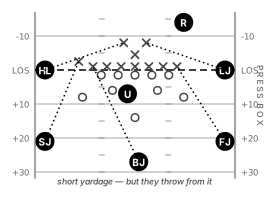
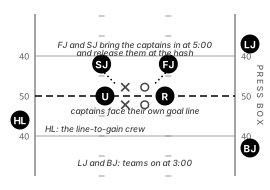
The marks on the diagrams: R referee, U umpire, HL head line judge, LJ line judge, SJ side judge, FJ field judge, BJ back judge. The press box is on the right of every diagram, which is where the Line Judge, Field Judge and Back Judge work; the manual's own MechaniGrams draw it on the left.
Download the 2022 7-man mechanics manual (PDF, 12 slides) — the VFOA's original slide deck, kept as the association's own record. Where the deck and this page disagree, this page is the manual and the deck is four years old. The diagrams here are drawn from the manual's Part 5, not taken from the deck.
Coin toss
Free kicks
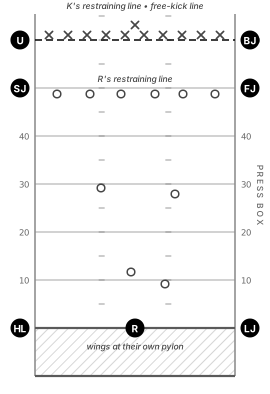
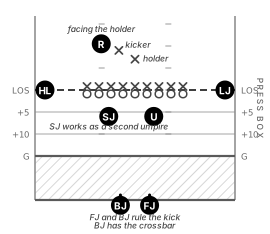
Positions (§5.7, p. 205).
- R — Centre of the field, on the goal line.
- U — K's restraining line (usually the 40), sideline opposite the press box. Count K and help manage the 5-yard belt.
- HL and LJ — Your own pylon on the goal line, or at least 10 yards deeper than the deepest receiver if you move up. Count R.
- FJ and SJ — R's restraining line (usually the 50).
- BJ — Count K. Don't give the kicker the ball until K has 11 on the field. Manage the 5-yard belt, hand him the ball with the instructions, then take K's restraining line on the press box side.
Who has whom (2026 Point of Emphasis, p. 8). This replaces the K2/K3/K4/K5 keying in the deck. The widest two players on each side of the kicking formation belong to the deepest official on that sideline, who stays stationary unless forced to move until the kick is possessed. Everyone else on Team K belongs to the officials on the two restraining lines, each taking the players on his own side. The official on K's restraining line also has action against the kicker. The Referee checks that at least four players are on each side of the kicker at the kick, and rules momentum or safety inside the 5 — when in doubt, touchback.
Onside kicks
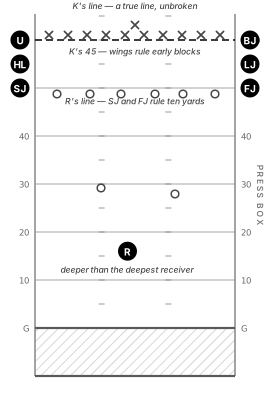
§5.7, p. 207. The deck has H/L and F/S the wrong way round.
- R — Centre of the field, deeper than the deepest receiver. Keep your distance, watch for low blocks, and you have the goal line.
- U and BJ — K's restraining line (usually the 40) — U opposite the press box, BJ on the press box side. You have K staying behind its free-kick line and whether the ball was "topped" off the tee. That restraining line is a true line and must not be broken before the kick.
- HL and LJ — K's 45. Rule whether K blocks before it is eligible to touch the ball, watch the ball immediately after it is kicked, and rule a topped kick that hits the ground. Be ready for a pop-up kick, first touching, a muff, and illegal or low blocks.
- FJ and SJ — R's restraining line. Primary responsibility for whether the ball goes 10 yards, whether it is touched or muffed, and a low block within 2 yards of the line.
- All — Nobody moves until the ball is beyond R's restraining line or is recovered. The officials on the side the ball is kicked take the ball — touched when, where and by whom; the officials on the opposite side take the blocks. Team K may not initiate a block until it can possess the ball, the ball has gone 10 yards, R has touched it, or R has already initiated a block.
- Clock — Wind on legal touching, not on illegal touching. If the returner is not grounded when he recovers, time comes off.
Goal line
§5.7, p. 211 and §5.8, pp. 213–214. The deck gives the Back Judge the goal line outside the 25; the manual gives him the end line.
- R — Normal position. You have the direction of a pass, forward or backward. Signal only once you are positive every requirement for a score is met and dead-ball action is over.
- U — Normal scrimmage responsibility. Do not signal a touchdown — let the wings and the deep officials rule it.
- HL and LJ — Goal line from the 7 and in; be on it. Outside the 7 you own forward progress to the 2. Tell your downfield partner on every play that you are taking all goal line rulings. Signal only if you saw the ball cross, and never mirror.
- FJ and SJ — Normal position outside the 25. From the 25 to the 7, on the goal line at the pylon. From the 7 and in, at the pylon on the end line. When a play ends on or near the goal line you must be on it. The goal line and your sideline are yours.
- BJ — Normal position outside the 25. From the 25 and in, on the end line — you have primary end line coverage. In a tight power run formation with no split receivers, you have low blocks by linebackers and lead blockers.
Reverse goal line
The manual states this as reverse fade mechanics (§5.8, p. 216): on a change of possession with a defensive return, HL and LJ become responsible for the goal line and FJ and SJ become responsible for forward progress — the exact reverse of the normal division. Everything below is the VFOA deck's own backed-up mechanic and is not in the manual:
- R, SJ, FJ and BJ — Cover plays as you normally would.
- U — Line of scrimmage responsibilities for plays inside the 10 yard line.
- HL and LJ — Move immediately to the goal line for plays snapped from the 3 and in. If snapped from the 3 to the 7, HL should hold the line of scrimmage and LJ should move back to the goal line with R to help with forward progress.
Punts
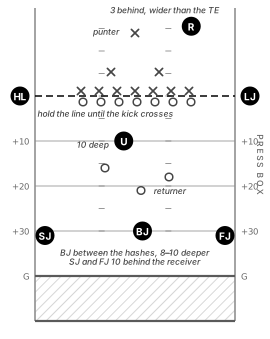
Field goals and trys
Measurements
§5.6, p. 203. The deck gives the down box to S and the spare ball to F; the manual gives the box to HL and the spare ball to BJ or LJ.
- R — Rule whether the ball is beyond the front rod.
- HL — Have the box moved behind the lead rod first, then bring the chain in from the sideline with the crew. Keep a hand on the links either side of the clip so the right link survives if the clip falls off. Clip goes on the back edge of the line. Say out loud what the next down will be either way — "it will either be first or fourth."
- LJ — Mark with your foot the intersection of the 5-yard line where the chain is clipped and a line through the ball parallel to the sideline. That is where H puts the clip.
- U — Take the front rod from the crew once H says he has the chain on the proper mark, then pull it taut.
- BJ — Hold the ball in place from the downfield side, facing Team A's goal line. Either you or L gets the spare ball from A's ball helper; if you have it, toss it to L before the measurement.
Scrimmage plays
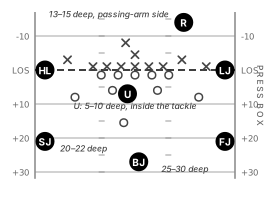
Positions (§5.7, p. 209).
- R — 13 to 15 yards deep on the quarterback's passing-arm side, at least a yard outside the tight end position. Count the offence before every play and have the Umpire acknowledge it.
- U — 5 to 10 yards deep, not outside the tackle. Vary your position. Key the centre and the two guards, and be alert for false starts. Count the offence and signal it to the Referee every play.
- HL and LJ — Read the formation and identify your eligible receiver. Shut the play down on a false start or encroachment. L has the tackle on his side unless there are trips; H has the near-side tackle when there are trips to L's side.
- FJ and SJ — 20 to 22 yards deep. Count the defence every play and acknowledge with B. You have the game clock.
- BJ — 25 to 30 yards deep. Count the defence, signal, and acknowledge with F and S. You have the play clock.
Pass keys
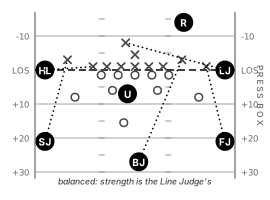
§5.3, pp. 186–199. In a balanced formation, strength is always declared to the Line Judge's side.
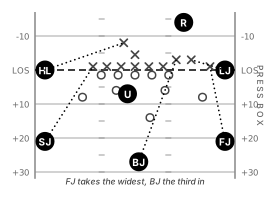
- FJ and SJ — Widest receiver on your side.
- BJ — Balanced: the flanker on the strong side. Trips: the third receiver in on the trips side. Double tight ends: the inside receiver on the line.
- HL — Balanced: the inside receiver on your side (usually the tight end). Trips to L's side: the fullback. Double tight ends: the halfback.
- LJ — Balanced: the back. Trips to your side: the motion or inside receiver.
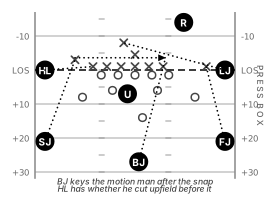
- All — Legality of motion always belongs to the official the player is moving away from, even if he reverses and comes back. The official keying the motion man after the snap and the official responsible for whether he cut upfield before it are often two different people.
Fade mechanics (§5.8, p. 215) are what makes a crew of seven work. F, S and B fade back on every pass and own the goal line except in short goal line situations; HL and LJ own forward progress on every play. FJ and SJ are not responsible for progress, so they must not creep in to get it — the best sideline ruling comes from 10 to 15 yards away. Don't move in until the play is over, short runs included, then angle in five to seven yards. A fast receiver closes a 20-yard cushion in two seconds. In a two-minute or hurry-up situation the deep officials may stop the accordion to keep pace.
Keys by formation